 Self-Leadership
Why Your Best Technician Makes Your Worst Manager
Promoting on technical skill alone creates a predictable leadership gap.
Why technical skill was never the whole job.
Every business has one. The leader who is technically unimpeachable — deep knowledge of the operation, a track record no one can dispute, unquestioned authority — and who has never once been required to examine how they treat people.
For a long time, this goes unchallenged. The leader delivers results. The business grows. Nobody asks the harder question: results at what cost, and to whom.
We've seen this pattern across manufacturing, mining, hospitality and corporate environments. A leader whose position was earned through technical mastery, tenure, or inherited authority — but never through relational capability.
Left unexamined, that leader defaults to control. This is not a personality quirk. It is an abuse of power, and it is specific. Information gets withheld selectively. People are excluded as punishment for asking "the wrong" question.
Administrative obligations — the unglamorous, procedural things a business owes its people — get slow-walked or buried. Not through incompetence, but because acting on them would cost the leader something they aren't willing to give up. And when something does go wrong, accountability gets redirected downward, onto whoever is easiest to blame.
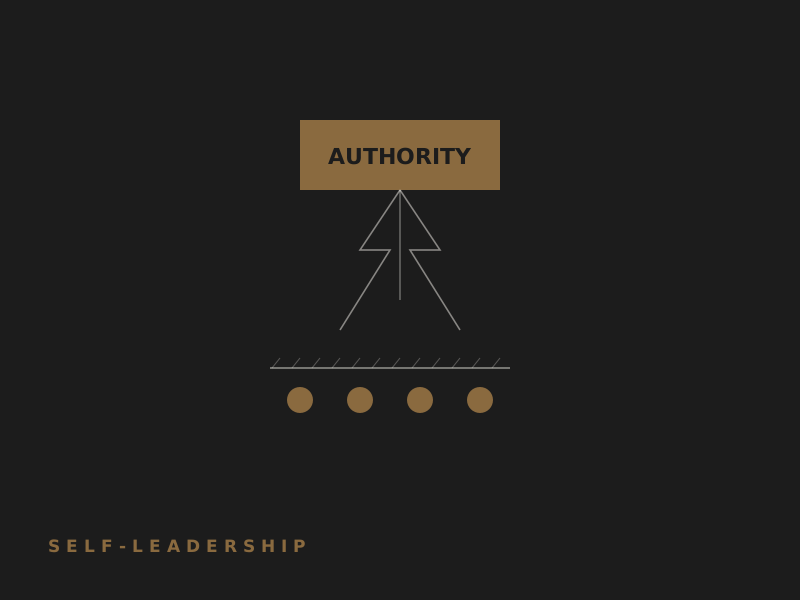
Authority was granted. Accountability was not. And where accountability is optional, it gets avoided.
The people underneath absorb the cost first: stress, disengagement, and in a number of cases, measurable harm to their mental health and even burnout. In the more serious instances, the cost is financial and direct — unresolved paperwork, delayed entitlements like payments, UIF, leave or IRP5s, obligations quietly left unmet, because meeting them would mean admitting fault.
The business absorbs the cost next. It just takes longer to show up. But it does — in attrition, disengaged teams, reputational exposure, and eventually, legal risk.
This is not a communication-skills problem. Sending that leader on a course about "difficult conversations" will not fix it.
The root cause is an absence of self-leadership. The leader has never had to look inward, because positional power has always protected them from having to. Authority was granted. Accountability was not — and where accountability is optional, it gets avoided.
This is the distinction that matters for any business trying to solve it. You cannot train your way out of a self-leadership deficit with generic leadership modules. The deficit is personal, not procedural, and the fix must start there.
Self-leadership development begins with the individual holding the authority — not the org chart around them.
The diagnostic work identifies precisely where technical or positional authority is being used as a substitute for relational accountability. The coaching that follows builds the capability the promotion assumed was already present — because competence in the role was never the same thing as fitness to hold power over people.
The outcome for the business is a leader who holds authority and trust at the same time, instead of one who has been quietly permitted to trade one for the other, at the expense of everyone under them.
We don't tell a business what's wrong with it. That determination is made together, against the business's own vision, values and real conditions — because a leader who is technically excellent and relationally unsafe is rarely visible from a job title.
It shows up in retention numbers. In what people are afraid to say in a meeting. In the issue that keeps quietly resurfacing because it was never actually resolved, only postponed until someone else had to carry it.
The question worth asking is not whether a business has strong technical leaders. Most do. The question is whether those leaders have ever been required to lead themselves first — or whether their authority has simply never been tested.
 Self-Leadership
Promoting on technical skill alone creates a predictable leadership gap.
 Accountability
Acknowledging fault while dodging its consequences is its own form of dishonesty.
No obligation. No generic proposal. Just a direct diagnostic discussion about what's actually happening in your business.
Take the DiagnosticQuick Diagnostic Enquiry