 Delegation
Delegation: What Stephen Covey Got Right
Delegation doesn't begin with communication. It begins with clarity within yourself.
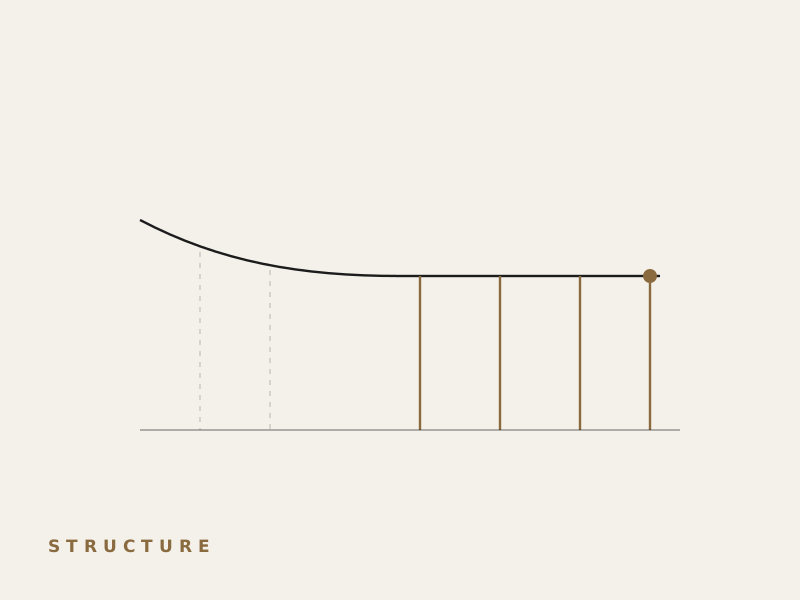
In most businesses, accountability has a reputation problem. It gets treated like a threat — something to brace for, deflect, or quietly negotiate down. Teams flinch at the word. Managers avoid the conversation until they can't.
Somewhere along the way, accountability became the enemy. It isn't. The absence of a system to hold space for it is.
Most businesses treat an accountability problem as a character problem. Someone missed a deadline, someone dropped a standard, and the conclusion is that they aren't conscientious enough, not committed enough, not the right fit — so they get performance managed out.
That conclusion is usually wrong. In my experience over the years, I've found the people are often willing, but misguided. What's missing is the system that was supposed to hold accountability in place — and it was never actually built. Blame the absence of that system, not the people standing in the gap it left behind. Where is the leadership?
Accountability is not a personality trait that some employees have and others lack. It is the output of a structure: clear ownership, a visible standard, a known consequence for the gap between the two, and a leader willing to close that gap consistently. Emphasis on consistently.
When that structure doesn't exist, accountability doesn't fail loudly. It erodes quietly, over time. Deadlines slip a little, then a little more. Standards get renegotiated informally, concessions made one exception at a time, until the exception becomes the norm. Nobody decided to lower the bar. It just happened, because no one owned the job of holding it.
Accountability is not extracted from people through pressure. It is built into a system that makes ownership the default, and safety the precondition for it.
This is why exhortation doesn't work. Telling a team to "own it" or "step up" does nothing if the structure underneath them was never built to support ownership in the first place.
Simon Sinek's Leaders Eat Last makes the case that accountability and trust are downstream of safety. When people don't feel safe — when admitting an error carries real personal cost, or when leadership itself is inconsistent — self-protection becomes rational.
People stop volunteering problems, stop flagging risk early, and stop taking ownership of outcomes they can't fully control. Sinek's central argument is that this isn't a motivation issue. It's a response to an environment leadership created.
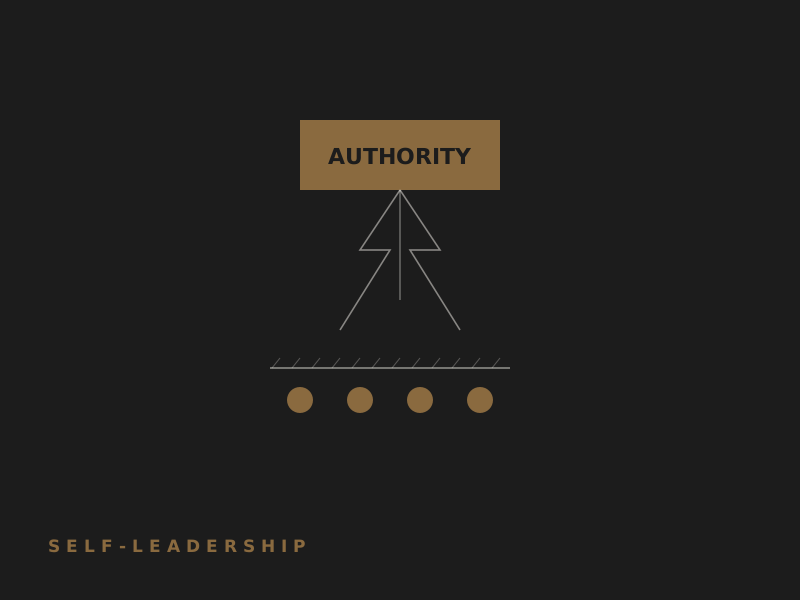
David Marquet's Turn the Ship Around! offers the sharpest practical model for the fix. As commander of the USS Santa Fe, Marquet inherited a chronically underperforming crew and rebuilt it not by demanding more accountability, but by redesigning who held authority to begin with.
His "leader-leader" model pushed decision-making down to the person closest to the information, replacing passive instruction-following — "permission to…" — with active ownership: "I intend to…"
Accountability rose not because the crew became better people overnight, but because the structure now required, and enabled, ownership at every level — instead of concentrating it at the top and hoping it would trickle down.
Read together, the two make the same point from different angles.
None of this happens automatically, and it doesn't happen because a manager is well-intentioned. It happens because a manager has done the deliberate work of building it — which is, itself, an act of self-leadership.
A manager who has never examined their own consistency, their own tolerance for uncomfortable conversations, or their own instinct to control rather than delegate will struggle to build a structure that requires exactly those things of them first.
Accountability was never the enemy. It's a value that management builds for a team, and models before asking anyone else to meet it. Leaders lead by example. Once the structure exists, it stops being something people brace for and starts being something they can rely on.
References
Sinek, S. Leaders Eat Last: Why Some Teams Pull Together and Others Don't. Portfolio, 2014.
Marquet, L. D. Turn the Ship Around! A True Story of Turning Followers into Leaders. Portfolio, 2012.
 Delegation
Delegation doesn't begin with communication. It begins with clarity within yourself.
 Self-Leadership
A leader can be technically unimpeachable and still relationally unsafe.
No obligation. No generic proposal. Just a direct diagnostic discussion about what's actually happening in your business.
Take the DiagnosticQuick Diagnostic Enquiry