 Self-Leadership
The Cost of Unsafe Leadership
A leader can be technically unimpeachable and still relationally unsafe. The people underneath absorb the cost first.
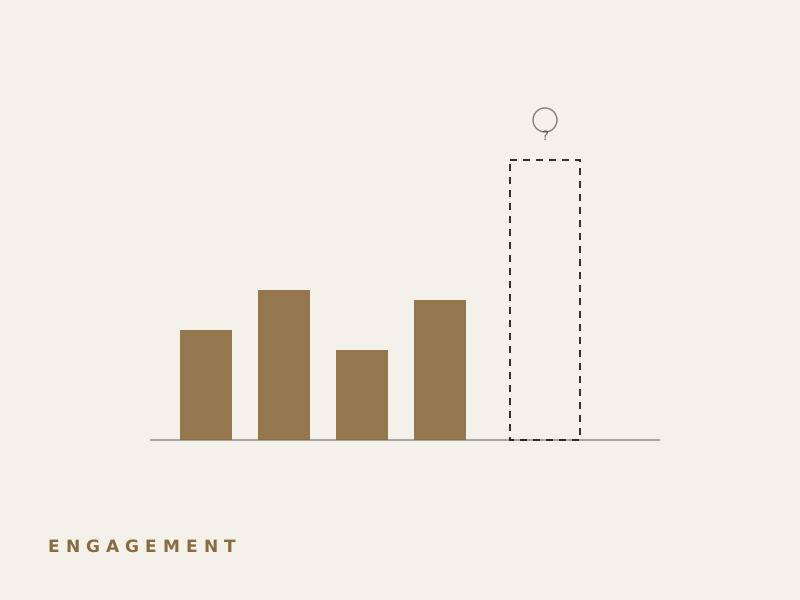
A line item most Exco meetings never see. So let the numbers speak.
What is the impact of team engagement, or the lack of it? Most executive committees can quote cost of sales, gross margin, headcount cost and overtime spend to the decimal. Ask the same room what disengagement is costing the business, and the answer is usually a shrug — or a reference to "culture" as something soft, unmeasured, and someone else's problem. Usually the head of HR's.
That gap is not a minor oversight. It's one of the most expensive blind spots in modern business, and it is measurable.
Gallup's State of the Global Workplace research is the largest continuous study of its kind, drawing on over 5.7 million respondents across more than 140 countries since 2009. Its most recent findings are not encouraging. Global employee engagement fell to 20% in 2025 — its lowest level since 2020 — costing the world economy an estimated $10 trillion in lost productivity.
That is not a rounding error. Each percentage point of global engagement represents roughly 21 million workers. The decline of recent years reflects tens of millions of people who have, in practical terms, checked out of their jobs while remaining on the payroll.
The trend inside management ranks is worse than the average. The largest year-over-year drop in manager engagement happened between 2024 and 2025, falling five points from 27% to 22%. Managers, who were once more engaged than the people they led, are now tracking at or below them.
Roughly 70% of the variance in team engagement is attributable to the manager. It is not primarily a function of pay, perks or policy.
This matters to Exco specifically, because Gallup's research also identifies where engagement is actually driven from: roughly 70% of the variance in team engagement is attributable to the manager. Engagement is a function of the person the employee reports to, every day, in the ordinary conduct of the job.
Put those two findings together and the exposure becomes clear. The group with the single largest influence over engagement is also the group whose own engagement is collapsing fastest.
Engagement doesn't fail the way a machine fails, with a visible, timestamped breakdown. It erodes. Analyst Josh Bersin, whose research has tracked the workforce for close to two decades, has described the current moment as an engagement and workplace happiness crisis — one playing out against a backdrop of otherwise unprecedented technological capability. Organisations invest heavily in tools and platforms while the human experience of work continues to decline.
That mismatch is the core of why boards miss it. Capital expenditure, technology investment and headcount are line items with clear owners and clear reporting cycles. Disengagement is diffused. It shows up as a resignation here, a missed deadline there, a customer complaint logged as an isolated incident rather than a symptom.
Without a mechanism to aggregate those signals, Exco sees anecdotes where it should be seeing a trend line.
At the global level, the numbers are abstract. Inside one organisation, they translate into specific, budget-relevant costs:
None of these show up on a single line in the management accounts labelled "disengagement." They're scattered across turnover, quality and service costs — which is exactly why Exco underestimates the total.
This is where the data and our methodology meet. Gallup's finding that managers account for most of the variance in team engagement is not a call for better perks or a revised engagement survey. It is a direct statement that engagement is a leadership capability problem before it is anything else.
A manager who was promoted for technical mastery, and has never developed the self-leadership required to hold people accountable, communicate under pressure and build trust, will suppress engagement in everyone below them — regardless of how good the company's benefits package is.
What gets measured gets managed. Exco already tracks safety incidents, quality defects and financial variance as leading indicators of business health. Engagement, if measured properly — at the level of the manager and team, not just the organisation as a whole — deserves the same discipline. The businesses that treat it as a strategic metric, owned at Exco level, are the ones positioned to convert Gallup's global crisis into a competitive advantage rather than an inherited cost.
The question for any Exco is not whether disengagement is costing the business. The data says it is. The question is whether the business is willing to measure it, trace it to its source, and address the root cause — by starting with the leaders who carry 70% of the influence over it.
References
Gallup. State of the Global Workplace: 2026 Report.
Bersin, J. "Employee Engagement and Happiness Crisis: What Should We Do?" The Josh Bersin Company, 2025.
 Self-Leadership
A leader can be technically unimpeachable and still relationally unsafe. The people underneath absorb the cost first.
 Retention
High staff turnover is rarely about pay. Here's what really drives good people out.
No obligation. No generic proposal. Just a direct diagnostic discussion about what's actually happening in your business.
Take the DiagnosticQuick Diagnostic Enquiry