 Culture
Accountability Is Not the Enemy
Accountability isn't a character trait. It's the output of a structure most businesses never built.
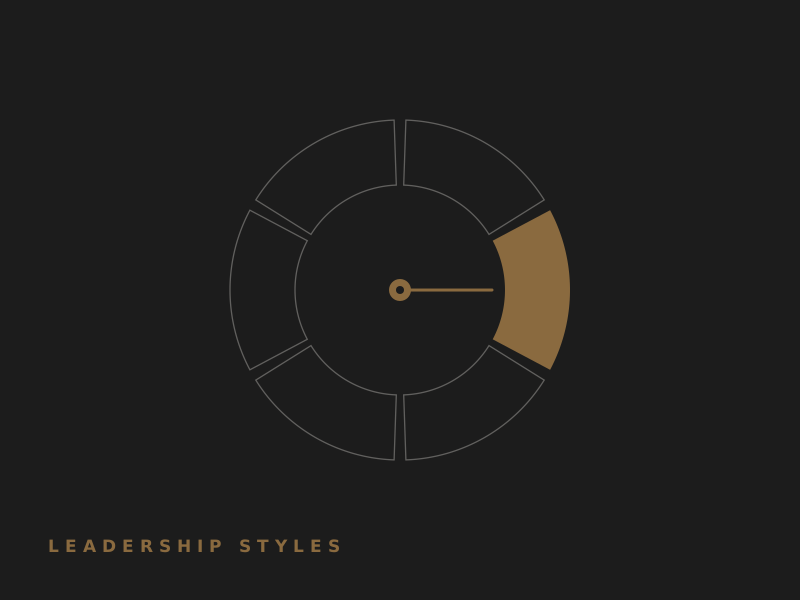
Most managers have a leadership style. Very few chose it.
It formed under pressure, copied from a past boss, or hardened around whatever got them promoted. When that default no longer fits the situation, the cost shows up in the numbers: slow execution, low accountability, and good people leaving.
I recently presented leadership training to the senior management of an African parastatal. The point that sat at the centre of it applies to any organisation:
There is no best leadership style. There is only the right style for the moment, and the self-awareness to know which moment you are in.
It earns its place in change, growth and culture-building. The cost is over-reliance on the leader and burnout on both sides. In a study of 1,140 employees across 19 South African organisations, Lerutla and Steyn (2022) found transformational leadership was judged the most effective style. It also carries the highest expectations, and Bwalya (2023) notes those can tip into stress for followers and leaders alike.
This is also where coaching sits. Developing individual strengths through ongoing feedback builds bench strength and succession — but it is slow when the moment calls for speed.
It earns its place where compliance matters and goals are measurable. Lerutla and Steyn found it was the second most effective style, and the research they cite links it to environments where rules and regulations are critical. The cost is limited creativity and weak long-term motivation.
It earns its place in a genuine crisis or a safety-critical moment, when there is no time to consult. Used as a default, it kills initiative and morale. Bwalya (2023) links it to tense environments and high turnover.
It works with highly skilled, self-motivated specialists. Without real expertise in the team, it becomes drift. This is the one style the evidence is clearest about: Lerutla and Steyn found it negatively related to leader effectiveness, and the research they cite associates it with reduced trust in the leader. Delegation is not the same as abdication.
It earns its place in culture repair and rebuilding trust. The cost is difficulty holding firm lines when goals conflict. Bwalya (2023) flags the same tension between individual needs and organisational objectives. Lerutla and Steyn also note the strong fit between servant leadership and ubuntu-based values in the African context.
It builds buy-in and handles complex problems well. It is too slow when a crisis demands one clear call.
Lerutla and Steyn tested whether leaders from different cultural backgrounds are judged differently by their teams. They are not. Whether a leader was black or white, transformational and transactional behaviour were both rated effective, and laissez-faire was rated ineffective. Their conclusion is that the best leaders apply both transformational and transactional styles, depending on the situation at hand.
Notice what that means for a CEO. The question is not "which style are we?" It is "can our managers read the situation and choose?"
Your managers are technically excellent. That is why they were promoted. But under pressure, people revert to their default style. The autocratic manager becomes more autocratic. The consensus-seeker stalls. The hands-off manager disappears. That is where communication breaks down, accountability weakens and attrition rises.
Style flexibility is built on self-leadership. A leader who cannot see their own default cannot choose a different one.
That is the work I do with executive teams: finding the real pattern behind the performance problem, then building the self-awareness and accountability that lets leaders shift style when the business needs it.
A question for your next leadership meeting: which style does each of your senior managers fall back on under pressure — and does your business need it right now?
If you'd like that conversation, book a call.
Sources
Lerutla, M., & Steyn, R. (2022). Distinct leadership styles and differential effectiveness across culture: An analysis of South African business leaders. SA Journal of Human Resource Management, 20, a1957. doi.org/10.4102/sajhrm.v20i0.1957
Bwalya, A. (2023). Leadership styles. GSJ, 11(8), 181–194.
Forbes Advisor. Management styles. forbes.com/advisor/business/management-styles
 Culture
Accountability isn't a character trait. It's the output of a structure most businesses never built.
 Delegation
Delegation doesn't begin with communication. It begins with clarity within yourself.
No obligation. No generic proposal. Just a direct diagnostic discussion about what's actually happening in your business.
Take the DiagnosticQuick Diagnostic Enquiry